Plan your visit to Remastered in Rotterdam
Remastered Experience is a 60-minute immersive digital-art attraction beneath Rotterdam’s Erasmus Bridge, best known for reimagining Dutch Masters through projection, sound, LED environments, and interactive rooms. This is not a traditional museum visit: the route is fixed, the rooms are dark and sensory, and the experience works best if you arrive on time and don’t rush the opening interactive sections. This guide covers the timing, tickets, route, and practical details that make the visit smoother.
Quick overview: Remastered at a glance
- When to visit: Timed-entry sessions run throughout the day. Weekday late afternoons are noticeably calmer than Saturday midday slots, because family and rainy-day demand tends to bunch up in the middle of the day.
- Getting in: From €25.95 for standard entry. Pre-book if you want a specific weekend or holiday slot, while weekday same-day availability is usually easier.
- How long to allow: 60 minutes for most visitors. Budget 75–90 minutes total if you want time for early check-in, lockers, the terrace, and photos.
- What most people miss: The draw-and-scan art station near the start and the outdoor terrace under the Erasmus Bridge are the two parts people rush past most often.
Jump to what you need
🕒 Where and when to go
🗺️ Getting around
🎨 What happens inside
♿ Facilities and accessibility
Where and when to go
How do you get to Remastered?
The venue sits on Rotterdam’s riverside at Willemsplein, directly beneath the Erasmus Bridge, and works best as part of a waterfront plan rather than a standalone cross-city detour.
Willemsplein 79, 3016 DR Rotterdam, Netherlands → Open in Google Maps
- Walk: Erasmus Bridge/Willemsplein waterfront → 2–5 min → easiest if you’re already near the river or a harbour activity.
- Taxi/rideshare: Willemsplein 79 → direct drop-off → the simplest choice if your slot is close and you don’t want to risk being late.
Which entrance should you use?
There is one main entrance, and the mistake most visitors make is assuming any door under the bridge is the right one. Stick to the timed-entry entrance for ticket scanning and don’t cut arrival too fine.
- Main entrance: Located at Willemsplein 79 beneath the Erasmus Bridge. Best for all timed-entry visitors. Expect the slowest check-in on Saturday afternoons and school-break slots.
When is Remastered Experience open?
- Opening hours: Timed-entry sessions run throughout the day, but the first and last slots vary by date.
- Late hours: Friday and Saturday usually have later evening availability than the rest of the week.
- Last entry: Your final bookable slot depends on that day’s live schedule.
When is it busiest? Saturday afternoons, rainy-day weekends, and school-break periods feel busiest because this is a short indoor attraction with strong family appeal.
When should you actually go? Weekday late afternoons usually feel easier because the midday family rush has passed, and you still have time afterwards for the waterfront or a cruise.
How do you get around the Remastered Experience?
This is a compact, fixed-route immersive venue rather than a free-roam museum, so navigation is easy once you’re inside but hard to redo if you rush through the early rooms.
Inside the route
- Interactive playground: Draw and scan your own 3D digital art → best place to slow down early → 10–15 min.
- Pixel waterfall and transition rooms: The first big sensory shift into the experience → strong visual payoff → 5–10 min.
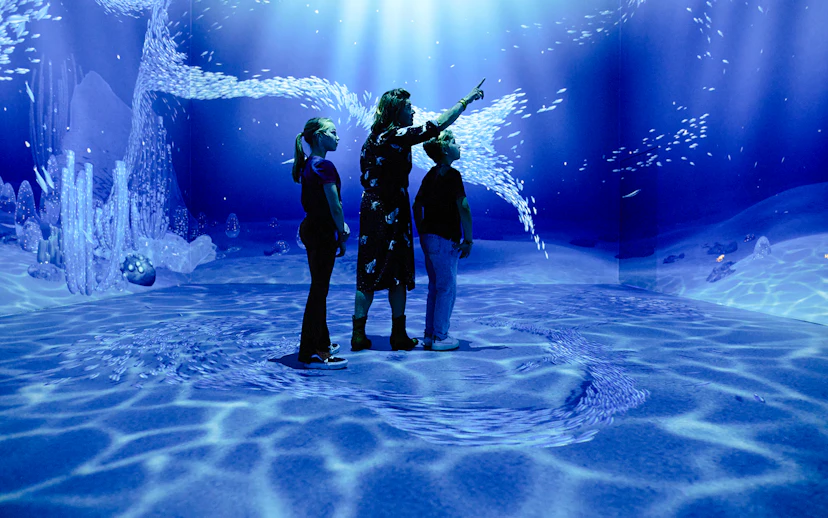
- Underworld and cloud scenes: Digital fish, softer visuals, and some of the most playful spaces → good for photos → 10–15 min.
- Bosch-inspired worlds and final show: The most dramatic part of the route and the strongest artistic payoff → save your attention for this → 25–30 min.
Suggested route: Follow the route in sequence and don’t burn through the opening rooms just because the visit sounds short — many visitors rush the interactive art, then wish they had slowed down before the Bosch section and final show.
Maps and navigation tools
- Map: This is a set-route experience rather than a multi-wing venue, so you won’t need a detailed floor map before arrival.
- Signage: Wayfinding is straightforward because room-to-room transitions and staff flow keep visitors moving in sequence.
💡 Pro tip: Stop and scan your drawing when you reach the interactive art area — it’s the only part where you add your own work, and people who hurry toward the waterfall often realise too late that they skipped it.
What happens inside the Remastered Experience?

Interactive art playground
Creator: Dutch digital artists
This is the most participatory part of the route. You create your own drawing, scan it, and watch it appear as part of the digital environment, which makes the experience feel personal rather than purely spectacular. Most visitors treat it like a warm-up, but it’s one of the few moments where you actively shape what you see.
Where to find it: Near the start of the route, before the larger projection rooms.
Pixel waterfall
Experience type: Immersive projection transition
The pixel waterfall is the first real ‘you’re inside it now’ moment. It acts as the gateway from the real world into the digital one, and it does a lot of work fast: scale, light, sound, and movement all shift at once. People often photograph it quickly and move on, but it’s worth pausing long enough to let the visual effect land properly.
Where to find it: Early in the route, after the opening interactive area.
Underworld with digital fish
Experience type: Interactive underwater environment
This section is calmer and more playful than the louder spectacle rooms. The digital fish respond to movement, which makes it one of the easiest parts of the visit for children, couples, and anyone who prefers interaction over standing still. It also gives the route some pacing variety, and that contrast is part of why the final show hits harder later.
Where to find it: Mid-route, after the more theatrical transition rooms.
Bosch-inspired worlds
Artistic reference: Hieronymus Bosch
Bosch translates unusually well into immersive digital art because his creatures and symbolic landscapes already feel dreamlike and cinematic. This is where Remastered becomes more distinctive than a generic projection show, because the material itself is strange, dense, and slightly unsettling. Visitors often remember the scale of the room, but the real payoff is noticing how Bosch’s surreal imagery becomes movement and atmosphere.
Where to find it: In the later half of the route, before the finale.
Final Dutch Masters show
Experience type: Large-scale audiovisual finale
This is the signature moment and the clearest reason to book. Instead of viewing Dutch Masters one by one, you stand inside a full audiovisual reinterpretation where color, geometry, texture, and motion take over the room. The show lasts about 30 minutes, so it’s not a quick ending — it’s effectively the main event, and it rewards arriving with enough mental energy left.
Where to find it: At the end of the route, in the final show space.
Facilities and accessibility
- 🎒 Lockers: Lockers are worth using if you arrive with extra layers or a bulky bag, because the route is dark, interactive, and easier with your hands free.
- 🚻 Restrooms: Use the restrooms before the route begins, because this is a timed, continuous experience rather than a stop-and-start gallery visit.
- 🪑 Seating/rest areas: The final show is the best point to pause and take in the visuals without needing to keep moving.
- 🌆 Outdoor terrace: The terrace under the Erasmus Bridge gives you a breather and skyline views before or after the indoor route.
- 🔊 Sensory conditions: Expect loud music, dark rooms, smoke effects, and surreal visuals rather than a quiet museum setting.
- ♿ Mobility: The venue is listed as wheelchair accessible, but you’ll still want to be comfortable moving at the set pace through dark rooms and transitions.
- 👁️ Visual impairments: This attraction depends heavily on projected light, scale, and motion, so it is less rewarding if strong sightlines are important to how you experience a space.
- 🧠 Cognitive and sensory needs: The combination of darkness, loud sound, smoke, and Bosch-inspired imagery can feel intense, so quieter weekday slots are the better choice if sensory load matters.
- 👨👩👧 Families and strollers: The short indoor format helps, but the darker sequences and louder finale are usually a better fit for older children than very young kids.
This works best for school-age children, teens, and older kids who enjoy screens, movement, and interactive visuals more than traditional museum labels.
- 🕐 Time: 60 minutes inside is realistic for most families, and 75–90 minutes total is a safer plan if you want a relaxed pace.
- 🏠 Facilities: The short fixed route and family ticket option make this easier to manage than a half-day attraction on a rainy Rotterdam day.
- 💡 Engagement: Let children make their own digital drawing near the start, because it gives them a personal stake in the rest of the experience.
- 🎒 Logistics: Arrive 15 minutes early and keep bags light, because late entry and juggling extras both feel more stressful in darker rooms.
- 📍 After your visit: A short Erasmus Bridge walk or nearby harbor activity works well if you want to extend the outing without another long indoor stop.
Rules and restrictions
What you need to know before you go
- Entry requirement: Use a timed-entry ticket and arrive at least 15 minutes early, because the route runs in sequence and late arrivals risk missing part of the experience.
- Bag policy: Travel light if you can, because darker rooms and interactive sections are easier to navigate without bulky bags, and lockers are useful if needed.
Not allowed
- 🚫 Food and drink: Keep food and open drinks outside the immersive rooms so the projections and equipment stay protected.
- 🚬 Smoking/vaping: Smoking and vaping belong in outdoor public areas, not inside the attraction.
- 🐾 Pets: Service animals only.
- 🖐️ Touching/climbing: Don’t climb on or handle scenic and technical elements, because most rooms are built around projection surfaces and equipment rather than physical play.
Photography
- Phone photography is part of why many people book Remastered, and the darker projection rooms are designed for that visual payoff.
- What matters is being respectful: keep flash off, avoid blocking the route for long photo setups, and don’t bring tripods or selfie sticks into tight, timed rooms where they slow everyone else down.
Good to know
- Sensory intensity: Loud sound, smoke, darkness, and Bosch-style creatures can feel intense, so this is better for older children than very young kids.
- Pacing: The final show lasts about 30 minutes, so don’t rush the opening rooms just because the full visit sounds short.
Practical tips
- Booking and arrival: Weekend and holiday slots are the ones to book first, and arriving 15 minutes early matters more here than at a museum because the route starts on a schedule.
- Pacing: Don’t treat the interactive drawing room as filler; it’s the only part where you add your own work, while the final show already gives you a built-in chance to slow down later.
- Crowd management: Weekday late afternoons usually feel easier than Saturday midday slots, because family demand clusters in the middle of the day and the 60-minute format turns over quickly.
- What to bring or leave behind: Bring a phone with battery and storage space for low-light photos or video, and keep bags light so you can move comfortably through darker rooms and transitions.
- Food and drink: Eat before or after, not in between, because the route is fixed and short, and this works better as a clean one-hour stop than a broken-up half-day outing.
- With kids: If anyone in your group is sensitive to loud music, smoke, or surreal imagery, mention that before the Bosch-inspired rooms so the experience feels exciting rather than overwhelming.
What else is worth visiting nearby?
Commonly paired: Spido harbour cruise
Distance: Same Willemsplein waterfront area — short walk
Why people combine them: This is the most natural pairing because both fit a waterfront Rotterdam plan, and the cruise adds real-city context after the immersive indoor visuals.
Commonly paired: Euromast
Distance: Riverside route away — easy same-day pairing
Why people combine them: Remastered gives you an indoor, one-hour culture hit, while Euromast adds Rotterdam’s most recognisable skyline perspective without turning the day into a museum crawl.
Also nearby
SS Rotterdam
Distance: Waterfront route away — better as a broader half-day pairing
Worth knowing: This works well if you want something more historical and maritime after Remastered’s digital approach.
Pancake boat
Distance: Nearby waterfront pairing — easy with families
Worth knowing: It’s the more playful add-on, especially if Remastered is part of a shorter family-friendly Rotterdam outing.
Eat, shop and stay near Remastered
Better options nearby: The Erasmus Bridge and Willemsplein waterfront area workafterwards better for a post-visit meal than a mid-visit snack, because the experience itself only lasts about an hour.
- Quick bite: A nearby coffee or light meal before your slot makes more sense than a long lunch if you’re arriving on a timed ticket.
- Post-visit plan: This is easiest to pair with dinner or drinks afterwards, especially if you’re combining it with a harbour cruise or evening walk.
💡 Pro tip: Book your slot first, then build food around it — Remastered is easiest to sandwich between another attraction and dinner, not the other way around.
The riverside around the Erasmus Bridge is convenient for a short stay, especially if you want easy access to Rotterdam’s modern waterfront and nearby attractions. It feels more like a practical sightseeing base than a deep neighborhood stay, which works well for one or two nights. If you want more evening energy, broader dining choice, or a more central city feel, you may want to sleep elsewhere and just visit this area for the attraction.
- Price point: Waterfront locations usually skew mid-range to higher than average, with the main payoff being views and easy access rather than budget value.
- Best for: Short city breaks, couples, and visitors building a Rotterdam plan around the river, skyline, and nearby attractions.
- Consider instead: Central Rotterdam is a better fit if you want more walkable restaurant choice and easier all-day city coverage beyond the waterfront.
Frequently asked questions about visiting Remastered
Most visits take about 60 minutes inside. If you add the recommended 15-minute early arrival, possible locker use, and a few minutes on the terrace afterward, 75–90 minutes is the more realistic amount of time to block out in your day.
Yes, it’s smart to book in advance if you want a specific timeslot. Remastered is a timed-entry attraction, so the main issue isn’t a huge walk-up queue — it’s getting the slot that fits the rest of your Rotterdam day, especially on weekends and rainy days.
Arrive at least 15 minutes early. That gives you enough time for ticket scanning, lockers if you need them, and getting settled before the route starts, which matters more here than at a drop-in museum.
Yes, but small bags are the easier option. The experience moves through darker rooms and interactive spaces, so bulky bags feel more awkward than they would in a regular museum, and lockers are useful if you want to go hands-free.
Yes, phone photography is one of the main appeals here. The practical rule is to keep flash off and avoid long photo setups in narrow or timed spaces, because blocking the flow is more disruptive here than in a free-roam gallery.
Yes, you can visit with a group, but timed entry matters. Because the route is fixed and relatively short, larger groups work best when they book the same slot rather than trying to assemble on arrival.
Yes, but it suits older children (6+). The one-hour format, digital fish, and interactive drawing element work well for families, while the darker rooms, loud music, smoke, and Bosch-inspired imagery can feel intense for very young or more sensitive children.
Yes, the attraction is listed as wheelchair accessible. The main thing to know is that accessibility here is about a timed, sensory route rather than a static venue, so comfort with dark rooms and steady forward movement matters too.
Yes, the waterfront area around Willemsplein is easy to pair with food before or after your visit. The better strategy is to eat outside your slot, because the experience itself is only about 60 minutes and works best when you treat it as a clean, uninterrupted stop.
It’s much closer to an immersive show than a traditional museum. The visit is built around sound, scale, projection, and interaction rather than reading labels or moving at your own pace through a collection.
Yes, this is one of the better rainy-day choices in Rotterdam. It’s indoors, timed, easy to understand, and short enough to fit around other plans, which makes it especially useful when the weather rules out a longer outdoor sightseeing stretch.